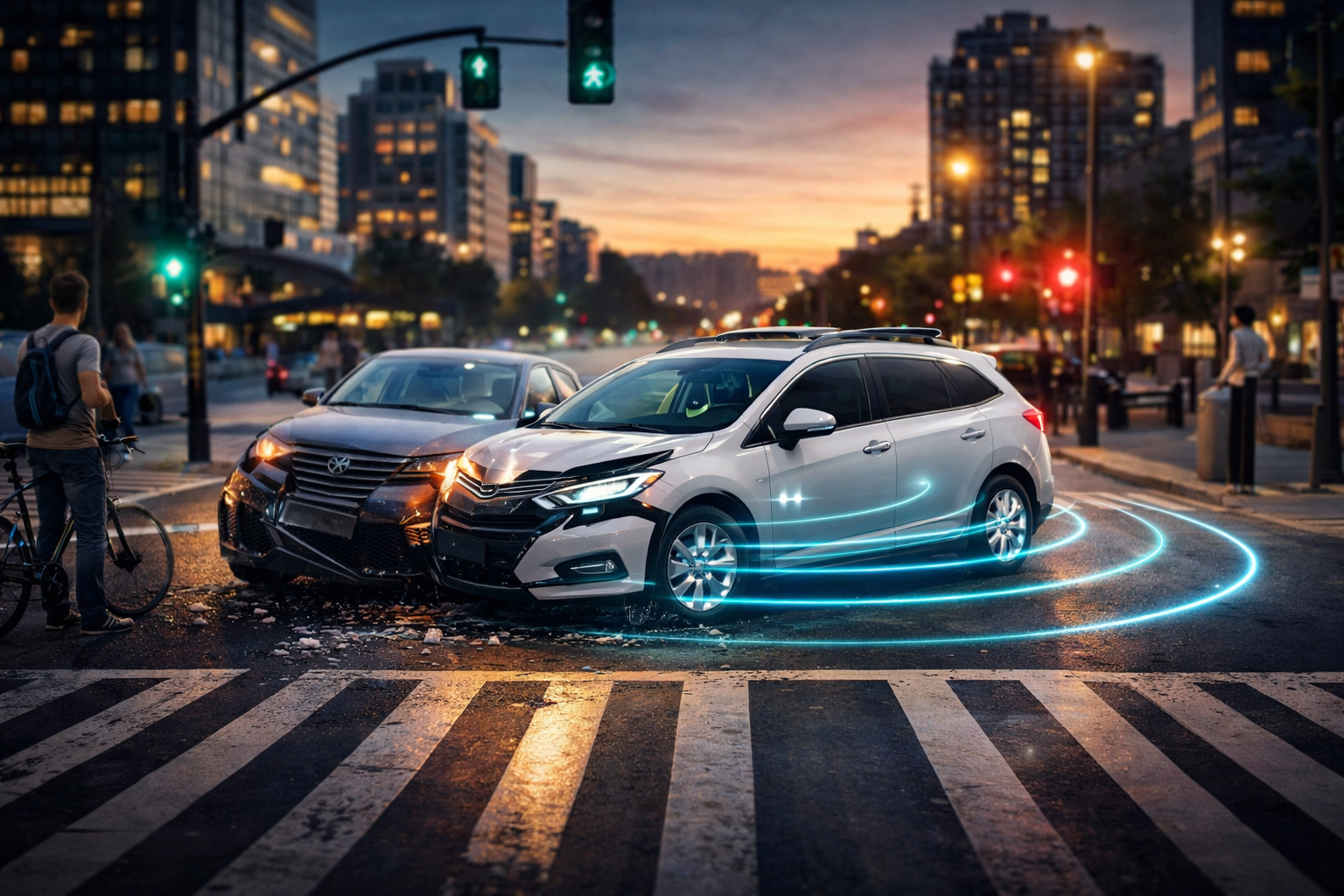
Self-driving technology is no longer a science-fiction topic. It is now part of real traffic, real insurance claims, and real injury cases. But when an autonomous vehicle, robotaxi, or partially automated car is involved in a crash, one question quickly takes center stage: who is actually responsible?
The answer is rarely simple. In a traditional crash, the focus is usually on the human driver. In a self-driving car case, liability may involve a human driver, a fleet operator, a vehicle manufacturer, a software developer, a maintenance provider, or even another motorist. In some cases, more than one party may share fault. That is why victims should move quickly to preserve evidence and understand how these claims work before accepting any settlement.
Not Every “Self-Driving” Crash Is the Same
One of the biggest mistakes people make is assuming every autonomous vehicle works the same way. Some vehicles only offer driver-assistance features such as lane centering, adaptive cruise control, or automatic braking. In those cases, the human driver is usually still expected to stay alert and take over at any time. Other vehicles, such as some robotaxis, may operate without a driver in limited service areas. That difference matters because it changes who had control at the moment of the crash.
If a human driver was supposed to monitor the vehicle and failed to do so, the claim may look more like a normal negligence case. If the vehicle was operating in a driverless mode, the investigation may shift toward the company running the fleet and whether the technology performed as it should have.
Who May Be Liable in an Autonomous Vehicle Injury Claim?
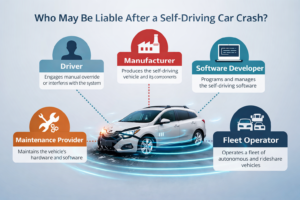
Several different parties may be legally responsible after a self-driving car crash:
- The human driver: If the vehicle was only partially automated, the driver may still be at fault for distraction, speeding, or failing to take control.
- The vehicle owner or fleet operator: A company operating robotaxis or test vehicles may be responsible for unsafe deployment, poor supervision, or failure to maintain the vehicle.
- The manufacturer: If a sensor, camera, steering component, braking system, or other vehicle part was defective, a product liability claim may be possible.
- The software or automated driving system developer: If the crash happened because the system misread traffic, failed to detect a pedestrian, or made an unsafe driving decision, software performance may become part of the case.
- A maintenance contractor: Bad repairs, poor calibration, or ignored service issues can also contribute to liability.
- Another road user: In some crashes, a third-party driver, cyclist, or pedestrian may still share fault.
These cases do not eliminate ordinary fault rules. Shared-fault principles can still apply, which is why it helps to understand how comparative negligence can affect an injury claim and whether you can still recover compensation if you were partially at fault.
The Evidence That Often Makes or Breaks the Case
Autonomous vehicle cases are evidence-heavy. The most important proof is not always visible at the scene. A case may turn on digital records, software logs, sensor data, remote-assistance communications, app history, and update records. That means early preservation is critical.
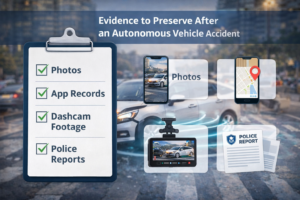
Victims should try to preserve:
- Photos and video of the crash scene, vehicle positions, skid marks, traffic controls, and visible damage
- Police reports and incident numbers
- Ride receipts, app screenshots, and trip confirmations if the crash involved a robotaxi
- Witness names and contact information
- Dashcam footage or nearby surveillance video
- Medical records, bills, and proof of missed work
- Any recall, software-update, or service notices connected to the vehicle
Medical evidence matters just as much as technical evidence. Some injuries appear after the adrenaline wears off, so it is smart to watch for delayed injury symptoms after an accident and get evaluated quickly. In more complex cases, lawyers may also need expert witnesses to explain system behavior, crash mechanics, medical causation, and future damages.
How Insurance Works When a Self-Driving Car Is Involved
Insurance can become complicated fast. A self-driving crash may involve personal auto insurance, commercial fleet insurance, umbrella coverage, and product liability insurance. In no-fault states, injured people may also need to start with their own benefits before pursuing additional claims against other parties. That is why it helps to understand what PIP covers and what it does not cover.
Insurance companies may still use familiar tactics even when the technology is new. They may argue that the victim caused the crash, that the injuries are unrelated, or that the software performed correctly. They may also push a quick offer before the full facts are known. If that happens, be cautious. Review the warning signs of a lowballed injury claim and learn when it may make sense to reject a settlement offer.
When a Self-Driving Car Crash Becomes a Product Liability Case
Not every autonomous vehicle crash is just a driving-error case. Sometimes the core problem is a defective product. A product liability claim may be worth exploring when the automated system failed to recognize a hazard, reacted too late, accelerated unexpectedly, made an unsafe lane change, or operated with a known defect that should have triggered a recall or software fix.
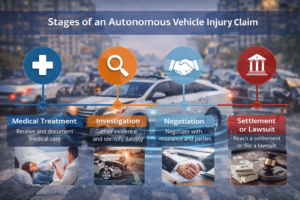
These claims often focus on whether the vehicle or system was unreasonably dangerous, whether safer alternatives existed, and whether the company failed to warn users about known limits. The challenge is that product cases are technical. Companies may hold large volumes of testing data, internal records, and engineering materials. That is one reason these cases often take longer than ordinary claims. If you want a sense of the process, here is a helpful guide on how long personal injury settlements can take.
What Injured Victims Should Do Right Away
If you are hurt in a crash involving a self-driving car, take the same safety steps you would after any serious collision, but add a stronger focus on digital evidence:
- Get medical care immediately. Your health comes first, and prompt treatment helps document the connection between the crash and your injuries.
- Call law enforcement and make a report. Do not assume the company’s app report is enough.
- Preserve app and trip data. Save screenshots, emails, ride confirmations, and any in-app messages.
- Document the scene. Photograph the roadway, traffic lights, crosswalks, weather, signage, and all vehicles involved.
- Avoid oversharing online. Insurance companies and defense lawyers may still use your posts against you, so read why social media can hurt a personal injury case.
- Speak with an attorney before giving detailed statements or accepting money. Once key digital evidence disappears, it can be difficult to rebuild the full story.
Helpful External Resources
- NHTSA: Standing General Order on Crash Reporting
- NHTSA: Automated Vehicles for Safety
- NHTSA: AV TEST Initiative
- NTSB: Student Pedestrian Investigation in Santa Monica
- NTSB: School Bus Investigation in Austin
- IIHS: Advanced Driver Assistance Research
- Nolo: Who Is Liable in a Self-Driving Car Crash?
Bottom Line
A self-driving car crash is still a personal injury case, but it can involve more layers of liability and more fragile evidence than a standard collision. The key questions are who controlled the vehicle, what technology was active, what failed, and whether the evidence was preserved before it disappeared. The sooner those questions are answered, the stronger the claim usually becomes.
